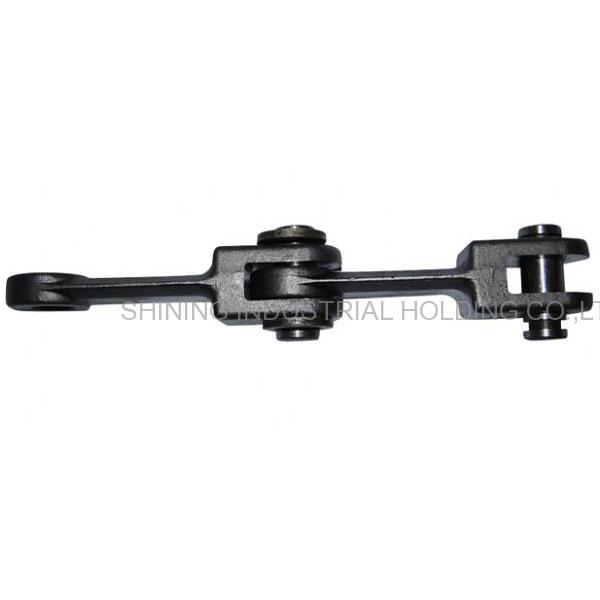


A cement plant runs on chains. Limestone and clay arrive on apron feeders at the primary crusher; raw meal crosses the preheater and kiln on high-temperature chains; clinker leaves the grate cooler on clinker and drag chains; the finished cement goes to the packing plant on scraper chain; and limestone, coal and slag are reclaimed at the stockpile by reclaimer chain. Every one of these duties is abrasive, dust-laden and often hot - and every one of them stops the plant when a chain fails.
SHINING has supplied cement-plant chain for more than twenty years, to cement producers and their maintenance contractors across North and South America, Asia, the Middle East, Europe, Russia and Africa. This page explains the problems a cement plant actually faces, how SHINING's design and material choices answer them, which chain fits which plant position, and what stands behind the product. Detailed dimensional tables for every chain we make are on the individual product pages - this page is here to help you choose.
1. The Challenge in a Cement Plant
Cement conveying is one of the most severe duty cycles in bulk material handling. The problems below are the ones plant maintenance and procurement teams raise with us most often:
● Hot, abrasive clinker destroys ordinary chain — Clinker leaves the grate cooler hot and highly abrasive. A standard conveyor chain wears at the pin and bush until its pitch grows, the chain rides high on the sprocket, and within a short time the chain jumps or snaps. Replacing it is a running cost the plant would rather not carry.
● Unplanned stoppages cost far more than the chain — A clinker or kiln line is the plant's heartbeat. When a chain breaks, the whole downstream line stops - and the cost of that downtime dwarfs the price difference between a cheap chain and a properly built one.
● Bucket elevator chain stretches and breaks buckets — In a bucket elevator the chain carries the full static and dynamic load of the buckets and their contents, continuously. Elongated chain changes the bucket spacing, causes spillage and can wreck the buckets above it. Limited space in the elevator housing also makes a bulky chain hard to fit and service.
● Fine, abrasive limestone and silo erosion — The limestone flow chain feeding the bucket elevator handles fine, abrasive limestone that erodes pins, bushes and attachments. Reclaimer chain works in the same aggressive stockpile conditions, where coal and slag add their own wear mechanisms.
● Long lead times and hard-to-source spares — Cement is a global industry, and plants run equipment from many OEMs. Finding a spare chain or sprocket on a reasonable lead time, at a reasonable price, is a genuine problem - especially for older or non-standard equipment.
● Sprockets are a hidden weak link — A worn sprocket eats a new chain. If the tooth profile does not match the chain's actual pitch, or if the rim cannot be replaced in place, every chain replacement costs the plant a bigger, longer shutdown than it should.
2. How SHINING Solves It
Material selection matched to the duty
Every cement chain starts with the right steel. Pins are made from a through-hardened alloy steel - typically 40Cr, 42CrMo or 40CrNiMo - so they combine high tensile strength with the toughness needed to absorb shock loading. Bushes and rollers are made from a carburizing steel such as 20Cr, 20CrMo or 20CrNiMo, carburized deep on every wearing surface; in special cases they are made from induction-hardened 42CrMo or 40CrNiMo. Sidebars are heat-treated 40Cr / 40Mn / 42CrMo alloy plate rather than plain carbon steel, so the link plate itself carries more load and resists bending.
Heat treatment as the core of wear life
Grade alone is not enough; the heat treatment is what sets service life. SHINING hardens, tempers, carburizes and induction-hardens in house. Pins are hardened through to a tough core and then induction-hardened on the surface; bushes and rollers are given an extra-deep carburized case. The result is a chain that resists elongation (wear at the pin and bush) far longer than a non-hardened chain - which is exactly the failure mode a cement plant pays for.
Hard-facing for hot clinker
For the hot-clinker drag run, where abrasion is at its worst, SHINING applies hard-face welding to the sliding and wear surfaces with a heavy weld bead. This gives excellent sliding-wear resistance in both cold and hot clinker service, and lets a worn chain be re-faced rather than scrapped.
Bucket elevator chain built for limited space
SHINING's elevator chain is based on the large-pitch conveyor chain standard with K443, K44, K24 and K35 bucket attachments, or the pre-calibrated 4004-G5 / 4065-G5 / 4037-G6 series with G5 / G6 attachments holding the buckets between the strands. The straight-sidebar design allows higher speed and capacity, and matched chain is pre-calibrated before dispatch so both strands run true. Connections are easy to make and break - important where the elevator housing is tight.
Manganese steel where impact is the enemy
For the most aggressive duties SHINING supplies Mn13 high-manganese cast chain and wear parts. Mn13 work-hardens under impact, so the harder the material hits it, the harder its surface becomes - the right choice for hot clinker, ore and aggregate drag conveyors and for feeder slats.
Forged chain for cooler and kiln discharge
Drop-forged link chain is used for the cooler and kiln discharge and for apron and pan conveyors, where a forged link outlasts a fabricated one. Forged links are produced from alloy steels, quenched and tempered, and surface-carburized where the duty demands it.
Scraper chain with robot-welded flights
Scraper chain runs wherever raw material is drawn from a bin, or finished cement is cleared at the packing plant - and there the flight is what fails, not the chain: the weld cracks and the scraper tears off. SHINING robot-welds the flights and attachments under a qualified welding procedure, so the weld is uniform and fully fused from the first flight to the last and the scraper stays fixed in service. The same applies to forged scraper and engineering scraper chain, in carbon, alloy and manganese steel.
Chain and sprocket engineered as one system
SHINING cuts every sprocket to the actual pitch of the chain it will run, so tooth and chain wear together instead of fighting each other. Split (two-piece) sprockets bolt around the shaft for replacement without dismantling the drive; segmental rims bolt onto a reusable hub so a large head sprocket can be re-rimmed in place - a shift's work, not a shutdown.
3. Application Navigator
Plant Position | Typical Chain / Sprocket | Why It Fits |
Primary crusher - apron feeder | 9842-WD-LR clinker chain; T171 traction chain (855 kN); Mn13Cr cast slats | F-type roller chain with cast manganese slats handles impact and coarse limestone up to 400 mm - or take the complete WBZ1524×5615mm heavy-duty apron feeder, chain and slats included. |
Limestone flow into elevator | P250-W620 limestone flow chain | Flow geometry and hardened pins resist fine, abrasive limestone. |
Vertical bucket elevator (raw meal, cement) | ER856 - ER984 bush chain; 4004-G5 / 4065-G5 / 4037-G6 | Large-pitch bush chain with K / G5 / G6 bucket attachments; pre-calibrated for matched strands. |
Grate cooler - hot clinker discharge | M-05-291 Mn13 drag chain; WHX6067 hard-face drag chain; 960 clinker chain | Manganese steel for impact, or hard-faced surfaces for hot sliding abrasion. |
Kiln inlet / preheater / grate cooler | High-temperature heat-resistant chain | Grade selected against the actual operating temperature and atmosphere. |
Cooler and kiln discharge - pan / apron | P142 / 14226 forged link chain; SCD630 forged apron chain | Drop-forged link outlasts fabricated chain under shock and heat. |
Bulk and packing scraper conveyors | P153-W460 hard-face chain; fabricated, forged-scraper and engineering scraper chain | Hardened wear surfaces and robot-welded flights, so the scraper itself does not break off. |
Finished cement to packing plant | P200-W245-EP scraper chain (wings every link) | High-speed, dust-tight transport of finished cement. |
Limestone, coal and slag stockpile | P315-A2 reclaimer chain; P180-A / B / C large-pitch chain | Hardened and tempered pins and bushes for the stockpile wear cycle. |
Trunk conveyors and feeders | P400 / P350 / P300 / P250 / P200 / P177.8 large-pitch chain; SCD630 / FU350 apron & scraper chain | Workhorse range; attachments in G4, K2 and wing form. |
Every position above | Matched solid, split and segmental sprockets | Tooth-cut to the actual chain pitch; split and segmental for in-place replacement. |
Every chain above is quoted with its matched sprocket as one set. Where your plant runs a chain we have not listed - including older or non-standard equipment - send the drawing or the OEM part number and we will quote against it.
Custom & Interchange Capability
● Direct interchange — SHINING chain and sprockets are dimensioned to interchange with the major international cement-chain brands, so they drop into an existing conveyor without changing the drive or the take-up. Send the OEM part number or the original drawing and we will confirm the match.
● Reverse-engineer from a sample — For obsolete or unbranded chain, send us a short length or a worn sample. We measure the pitch, plate and attachment geometry, agree the specification with you, and manufacture to it.
● Build to your drawing — Non-standard pitches, special attachments, custom scraper or flight spacing, alternative materials and surface treatment - all available. Tell us the duty (load, speed, temperature, material handled) and we will propose the grade.
● Sprockets to match any chain — We cut sprockets to the actual pitch of any chain, including other makers' chain already in your plant, in solid, split and segmental form, in steel or cast material.
● Sample before volume — For a new application we can supply a sample or trial length so your maintenance team can prove the chain on the line before committing to volume.
4. Built by SHINING
Cement plants buy from SHINING because the product is engineered and made in one place, and because the numbers behind it can be checked. SHINING has manufactured chain since 2003 from a 36,000 m2 base in Changzhou, Jiangsu, China, with dedicated forging and link-chain plants and a full in-house heat-treatment and testing capability.
Quality is controlled at every step: incoming material is spectrograph-verified, key characteristics are inspected through production, and every order ships with inspection reports and a certificate of conformance. If the chain does not perform as specified, you have a manufacturer to go back to - not a trading desk.
Area | What SHINING Provides |
Manufacturing base | 36,000 m2 main production site in Changzhou, Jiangsu, China, with dedicated forging and link-chain plants. |
In-house processes | Melting, forging, laser / flame / wire cutting, CNC turning, milling and grinding, robotic welding and shot blasting - all performed in-house. |
Heavy capacity | Press capacity up to 400 MT; robot welding for hard-faced and scraper chains; automatic link-chain production lines. |
Heat treatment | In-house hardening, tempering, case carburizing and induction hardening - the step that sets wear life. |
Quality control | Every incoming material batch inspected; dimensional, heat-treatment and tensile / fracture inspection through production. |
Testing lab | Tensile testing machine, hardness tester, roughness detector, spectrum analyser and chain-length measuring instrument. |
Certification | ISO 9001:2015 and ISO 14001:2015; inspection reports and certificates of conformance issued with every order. |
Worldwide supply | Exporting to cement, mining, steel, sugar, palm-oil, grain and material-handling plants across six continents. |
SHINING holds ISO 9001:2015 (cert. 46026Q00958R053) and ISO 14001:2015 (cert. 46026E00959R053) certification, issued by Shenzhen Huazhi (HZIC). Standard production lead time is 60 days.
Related Products
ER856 to ER984 with K24 / K35 / K44 / K443 bucket attachments, plus the pre-calibrated 4004-G5 / 4037-G6 elevator series.
F-type roller clinker chain driven by the 9842 split sprocket, with the T171 traction chain and Mn13Cr cast slats.
Flow chain carrying fine limestone into the bucket elevator, and the P315-A2 reclaimer chain for the limestone, coal and slag stockpile.
Drop-forged alloy-steel link chain with scraper for kiln and cooler discharge, built to the plant's drawing.
SHINING's own primary-crushing apron feeder: Mn13Cr cast slats, T171 tank-track chain (855 kN) and a 30 kW variable-frequency drive - the complete feeding unit, not only the chain.