


G100 Chain Selection Guide: Technical Guide for Professionals
 Feb 08, 2026|
 View:937
G100 Chain Selection Guide
-Technical Guide for Professionals
Introduction: Understanding the Critical Role of G100 Chains in Modern Industry
In today's demanding industrial landscape, selecting the appropriate lifting equipment is not just a matter of efficiency—it's a critical safety imperative. G100 alloy steel chains represent the pinnacle of lifting and rigging technology, offering superior strength-to-weight ratios and exceptional durability for the most challenging applications. According to industry data, proper chain selection can reduce equipment failure rates by up to 70% and extend service life by 40%. This comprehensive 3000-word guide will provide you with an in-depth framework to make informed decisions when choosing G100 chains for your specific operational needs, ensuring both safety and productivity.
The global chain hoist market, valued at $1.2 billion in 2023, continues to grow at 5.8% CAGR, with G100 chains capturing an increasing market share due to their superior performance characteristics. Understanding how to properly select these chains is essential for engineers, safety managers, and procurement specialists across various industries.
1. Understanding International Standards and Certification Requirements
1.1 Key International Standards for G100 Chains
G100 chains must comply with rigorous international standards that govern every aspect of their manufacture and performance. These standards ensure consistency, safety, and reliability across global markets:
ISO 3075:2019: This international standard specifies requirements for round steel short-link chains used in lifting applications. It covers grade classification, dimensional tolerances, testing protocols, and marking requirements. Chains certified to this standard undergo proof testing to 2.5 times the working load limit and must achieve a minimum breaking force of 4 times the WLL.
EN 818 Series: The European standard comprises multiple parts (EN 818-1 to EN 818-7) that cover the complete lifecycle of chains from manufacturing to inspection and retirement. EN 818-2 specifically addresses grade 80 and grade 100 chains, requiring comprehensive testing including fatigue testing at 2.5% of the minimum breaking force.
ASME B30.9: The American standard provides safety requirements for chain slings, including design factors, inspection criteria, and removal-from-service guidelines. It mandates a design factor of 4:1 for alloy steel chain slings.
1.2 Certification and Traceability
Reputable manufacturers provide full certification packages that include:
Material certificates with chemical composition analysis
Heat treatment records with temperature curves
Mechanical test reports (tensile, impact, hardness)
Dimensional inspection reports
Non-destructive testing results (dye penetrant, magnetic particle)
Expert Insight: Always request the original test certificates rather than statements of compliance. For critical applications, consider third-party verification from organizations like DNV, Lloyds, or ABS.
2. Material Science and Manufacturing Excellence
2.1 Advanced Alloy Steel Composition
G100 chains utilize sophisticated alloy steel formulations that typically contain:
Chromium (0.80-1.10%) for hardenability and corrosion resistance
Molybdenum (0.15-0.25%) for high-temperature strength
Manganese (0.75-1.00%) for toughness and wear resistance
Controlled carbon content (0.35-0.45%) for optimal strength-ductility balance
The precise chemical composition is crucial for achieving the required mechanical properties after heat treatment.
2.2 Precision Manufacturing Process
The manufacturing journey of a G100 chain involves sophisticated processes:
Material Selection and Verification: Raw material is sourced with strict chemical composition controls and subjected to ultrasonic testing for internal defects.
Precision Forming: Chain links are cold-formed using CNC machinery to maintain dimensional accuracy within ±0.5% of nominal dimensions.
Flash Butt Welding: Advanced computer-controlled welding machines create forged-quality welds that typically achieve 95-100% of the base material strength.
Heat Treatment Protocol: A three-stage process involving:
Austenitizing at 850-880°C
Quenching in oil or polymer solutions
Tempering at 450-500°C to achieve the optimal hardness of 340-380 HB
Quality Verification: Each production batch undergoes destructive testing where sample chains are tested to destruction to verify compliance with minimum breaking force requirements.
3. Comprehensive Technical Characteristics Analysis
3.1 Load Capacity Calculations
Understanding the relationship between chain diameter and working load limit is crucial:
| Chain Size | WLL (kN) | Weight/Meter | Strength/Weight Ratio |
| G100-6x18 | 14.0 | 0.8 kg | 17.5 |
| G100-10x30 | 39.0 | 2.4 kg | 16.3 |
| G100-16x48 | 100.0 | 6.04 kg | 16.6 |
| G100-22x66 | 190.0 | 11.3 kg | 16.8 |
Calculation Example: For a 10-ton load with dynamic factors of 1.5, you need a chain with minimum WLL of 15 tons. A G100-16x48 chain (WLL 10.2 tons) would be insufficient, while a G100-18x54 chain (WLL 12.95 tons) would be appropriate.
3.2 Fatigue Performance and Service Life
G100 chains exhibit exceptional fatigue resistance due to their refined microstructure. Testing under EN 818-4 standards requires chains to withstand:
40,000 cycles at 0.5% of minimum breaking force
30,000 cycles at 1.0% of minimum breaking force
20,000 cycles at 1.5% of minimum breaking force
The actual service life depends on application factors:
Ideal Conditions (controlled environment, proper lubrication): 10+ years
Severe Conditions (abrasive environments, high temperatures): 3-5 years
Extreme Conditions (chemical exposure, saltwater): 1-2 years
4. G100 vs. G80: Technical and Economic Comparison
4.1 Performance Advantages of G100 Chains
Strength and Weight Considerations:
G100 chains offer 25% higher strength than equivalent diameter G80 chains
This enables using smaller diameter G100 chains to achieve the same WLL, reducing weight by 15-20%
Example: A G100-13mm chain can replace a G80-16mm chain, reducing weight by 18%
Economic Analysis:
While G100 chains command a 15-25% price premium over G80 chains, their total cost of ownership is often lower due to:
Reduced Equipment Costs: Lighter chains require smaller hoists and supporting structures
Improved Productivity: Easier handling increases operational efficiency
Extended Service Life: Superior wear resistance reduces replacement frequency
4.2 Application-Specific Recommendations
Choose G80 When: Budget constraints are primary, applications involve static loads, and environments are non-corrosive
Choose G100 When: Dynamic loading occurs, weight reduction is valuable, or environments are corrosive/abrasive
5. Coating Technology and Environmental Adaptation
5.1 Advanced Coating Technologies
Modern G100 chains offer multiple coating options tailored to specific environments:
Blue E-Coat (Standard):
Epoxy-polyester hybrid coating
Thickness: 15-25 microns
Salt spray resistance: 250-400 hours
Maximum service temperature: 120°C
Hot-Dip Galvanizing:
Zinc coating thickness: 50-85 microns
Salt spray resistance: 1,000+ hours
Suitable for marine and chemical environments
Slight reduction in fatigue strength (5-8%)
Specialty Coatings:
Xylan® and Dymon®: Low-friction coatings for high-wear applications
Kemlube 1400: Food-grade coating for pharmaceutical and food processing
Zinc-Nickel Alloy: Superior corrosion protection (1,500+ hours salt spray)
5.2 Color Coding for Safety and Management
Color selection serves both functional and safety purposes:
Blue: Standard industrial applications
Orange/Yellow: High-visibility for safety-critical areas
Green: Food-grade and special industry applications
Red: Quality control and inspection identification
Implementing a color-coded system can reduce misapplication incidents by up to 65% according to industry studies.
6. Application-Specific Selection Guidelines
6.1 Mining and Mineral Processing
Requirements: Extreme abrasion resistance, impact toughness, corrosion protection
Recommended Specification:
Chain Size: G100-22x66 or larger
Coating: Hot-dip galvanizing with Xylan topcoat
Additional Requirements: Enhanced inspection every 250 operating hours
Expected Service Life: 18-24 months in primary crusher applications
6.2 Offshore and Marine Applications
Requirements: Superior corrosion resistance, certification to marine standards
Recommended Specification:
Chain Size: Based on ABS/DNV calculations with safety factor 5:1
Coating: Marine-grade galvanizing (85μm minimum)
Certification: DNV 2.7-1 or equivalent
Inspection: Quarterly detailed examinations
6.3 Manufacturing and Assembly Operations
Requirements: Precision handling, fatigue resistance, cleanliness
Recommended Specification:
Chain Size: Optimized for exact load requirements
Coating: Blue e-coat or zinc-nickel for clean environments
Special Features: Certified to ISO 9001/14001 for automotive applications
7. Supplier Evaluation Framework
7.1 Technical Capability Assessment
When evaluating G100 chain suppliers, consider these critical factors:
Manufacturing Capabilities:
In-house heat treatment facilities
CNC-controlled welding equipment
Automated quality control systems
Testing and Certification:
Third-party certification availability
Traceability systems (batch to final product)
Material test reports availability
Technical Support:
Engineering support services
Custom manufacturing capabilities
Failure analysis services
7.2 Total Cost of Ownership Calculation
Develop a comprehensive TCO model that includes:
Initial purchase price
Expected service life
Maintenance requirements
Downtime costs
Replacement frequency
Safety certification costs
Industry data indicates that premium-quality G100 chains typically demonstrate 25-40% lower TCO over a 10-year period compared to economy-grade alternatives.
8. Implementation and Maintenance Best Practices
8.1 Proper Installation Procedures
Always use matching components from the same manufacturer
Employ calibrated torque tools for assembly
Conduct initial load testing at 125% of WLL
Document all installations with photographic evidence
8.2 Comprehensive Inspection Regime
Implement a three-tier inspection system:
Pre-Use Inspection (Daily):
Visual examination for obvious damage
Functional testing of movement
Documentation of findings
Periodic Inspection (Monthly):
Detailed measurement of wear
Dimensional verification
Load testing sample chains
Certified Inspection (Annual):
Third-party verification
Non-destructive testing
Certification renewal
9. Emerging Trends and Future Developments
The G100 chain market continues to evolve with several significant trends:
Smart Chain Technology: RFID and sensor-equipped chains enabling real-time load monitoring and predictive maintenance
Advanced Materials: Nano-structured steels offering 15-20% strength improvements
Sustainable Manufacturing: Low-carbon footprint production processes and recyclable materials
Digital Twins: Virtual modeling of chain systems for optimization and failure prediction
10. Conclusion: Making the Optimal G100 Chain Selection
Selecting the right G100 chain involves a sophisticated balance of technical requirements, environmental conditions, economic considerations, and safety factors. By following the comprehensive framework outlined in this guide, you can ensure optimal performance, maximum safety, and lowest total cost of ownership.
Key Decision Factors Summary:
Prioritize Certification: Always select chains with full international certification
Match Coating to Environment: Choose specialized coatings for corrosive or abrasive conditions
Consider Total Cost: Look beyond initial price to evaluate long-term value
Implement Rigorous Maintenance: Establish comprehensive inspection and documentation procedures
SHINING's G100 chains are manufactured to the highest international standards, with full traceability and third-party certification. Our technical team provides comprehensive support from selection through implementation and maintenance. Contact us at sales@shiningco.com for personalized assistance with your specific application requirements.

Recommended Products

G100- 22x66mm Alloy Steel Round Link Chain- Ultimate Capacity

G100- 20x60mm Alloy Steel Round Link Chain- Ultimate Heavy-Lift Performance

G100- 18x54mm Alloy Steel Round Link Chain - Heavy-Duty Performance

G100- 16x48mm Alloy Steel Round Link Chain- Maximum Capacity for Critical Lifts

G100- 13x39mm Alloy Steel Round Link Chain- Superior Strength & Durability

G100- 10x30mm Alloy Steel Round Link Chain- Superior Strength & Durability

G100- 8x24mm Alloy Steel Round Link Chain - Superior Strength & Durability

G100- 6x18mm Alloy Steel Round Link Chain- Superior Strength & Durability

G100 Lifting Chain
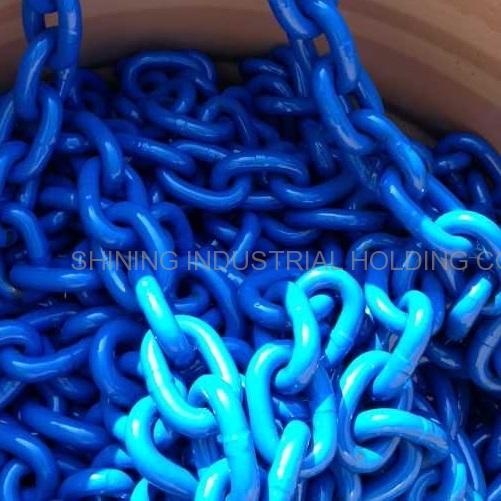
G100 lifting chains welded link chain


