


Beyond Price: Palm Oil Chain Selection Guide
 Mar 12, 2026|
 View:1268
The Ultimate Guide to Selecting the Right Conveyor Chain for Your Palm Oil Mill
-Beyond Price, Towards Productivity
Introduction: The Heartbeat of Your Palm Oil Mill
Within the relentless ecosystem of a palm oil mill, where profitability is measured in continuous throughput and minimized downtime, the conveyor chain is not just a component—it is the vital circulatory system. It bears the immense, abrasive load of Fresh Fruit Bunches (FFB) hour after hour, day after day, under some of the most punishing conditions in industrial processing. The choice of this chain is, therefore, one of the most critical operational decisions a mill manager or engineer can make. Selecting the wrong chain leads to a cascade of failures: unplanned stoppages, frequent replacements, soaring maintenance costs, and lost production. This guide moves beyond superficial price comparisons to delve into the engineering fundamentals that define a truly reliable FFB conveyor chain. We will explore how the right selection, combined with proper maintenance, is the cornerstone of achieving a service life of 12 months or more, transforming your chain from a recurring cost center into a pillar of operational resilience and profitability. As a pioneer with over two decades of experience powering industries globally, SHINING understands that in the world of palm oil, durability isn't a feature—it's the entire product.
Part 1: Understanding the Enemy – The Palm Oil Mill Environment
To select the right chain, one must first fully appreciate the extreme challenges it must overcome.
Abrasive Wear: FFB are not gentle cargo. They are rough, irregular, and often coated with abrasive sand and soil. The constant sliding, dragging, and impact during conveyance act like sandpaper on chain components, particularly the pins, rollers, and sidebar edges. This abrasion progressively wears down material, increasing pitch (chain elongation) and eventually leading to derailment or failure.
Corrosive Attack: The mill environment is saturated with moisture, organic acids from the fruit, and sometimes chemical cleaners. This creates a highly corrosive atmosphere that attacks bare metal, leading to rust and pitting. Corrosion weakens the metal microstructure and can accelerate wear, creating a vicious cycle of degradation.
High Dynamic Loads & Impact: Chains must handle not just the static weight of FFB, but also dynamic loads from starts, stops, and uneven loading. Impact forces occur as bunches are dropped onto the conveyor. These forces create stress concentrations that can lead to fatigue cracks and premature failure in under-engineered chains.
Marathon Operation: Palm oil mills are engines of continuous production, often operating 16-24 hours per day, 7 days a week. The chain has no time to "rest." This non-stop operation demands exceptional resistance to metal fatigue—the tendency of a material to fracture under repeated cyclic stressing.
Contamination: Mud, pulp, and fibrous material can ingress into chain joints, acting as grinding paste that accelerates wear and can impede proper lubrication.
A chain selected solely on a low price point is engineered to a cost, not to conquer these conditions. It will inevitably succumb, resulting in a higher total cost of ownership through relentless failures.
Part 2: The Anatomy of a Superior FFB Conveyor Chain: A Holistic Engineering Perspective
True quality and longevity are engineered in from the start. Here are the non-negotiable pillars of a high-performance FFB chain:
1. Design Philosophy: Purpose-Built for the Task
A chain for horizontal/long-distance FFB transfer (like on a 600-meter main conveyor) has different needs than one on a steep incline. The right design considers:
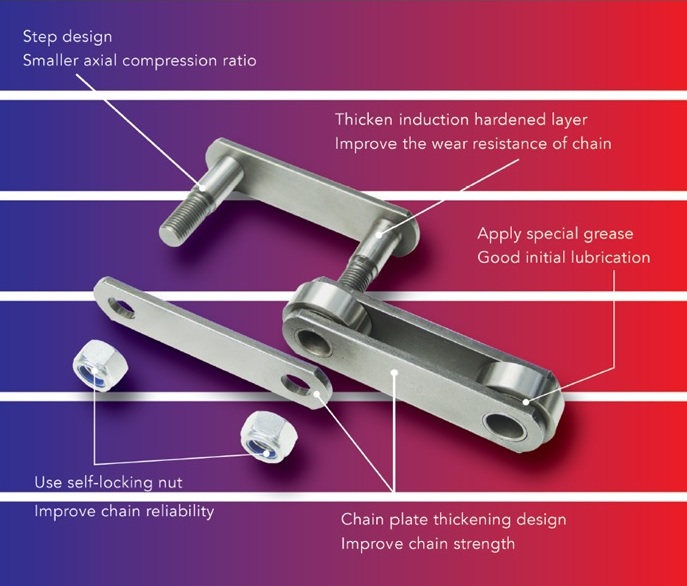
Link Plate (Sidebar) Profile & Thickness: Thicker sidebars (e.g., 9mm vs. standard 6-7mm) provide a greater cross-sectional area to resist tensile loads and fatigue. The profile must facilitate smooth engagement with sprockets and minimize stress risers.
Pin & Bushing Interface: This is the heart of the chain joint. The design must ensure optimal bearing pressure distribution. An extended screw pin with a robust locking nut (e.g., M24) is critical for incline chains to resist back-out under vibration, a common failure point.
Roller Design: Rollers must be precisely sized for smooth travel on tracks and resist crushing under load. Treatments to reduce material adhesion (e.g., certain platings or finishes) are beneficial.
2. Material Science: The Foundation of Strength
The choice of steel is paramount. Standard carbon steel lacks the necessary endurance.
Alloy Steel: Superior FFB chains are manufactured from specific grade alloy steels. These steels incorporate elements like Chromium, Molybdenum, and Nickel, which enhance hardenability, toughness, and fatigue strength at a microstructural level.
Material Integrity: Consistency is key. Reputable manufacturers use steel from certified mills with strict control over chemical composition and internal soundness (freedom from inclusions and voids that can become crack initiation points).
3. Heat Treatment: Unlocking the Potential of the Material
This is where the raw material is transformed. Different components require tailored processes:
Pins: Subjected to shear and bending forces. Surface Induction Hardening creates an extremely hard, wear-resistant outer case (e.g., 55-60 HRC) while retaining a tough, ductile core to absorb impact and prevent brittle fracture.
Bushings & Rollers: The bearing surfaces. Carburizing or Carbonitriding infuses carbon into the surface layer, followed by quenching. This creates a deep, hard wear surface ideal for the rolling/sliding contact with pins and tracks.
Sidebars (Link Plates): Subjected to high tensile and fatigue loads. Through Hardening and Tempering (Quenching & Tempering) is essential. This process gives the entire sidebar a uniform, high-strength microstructure with excellent toughness. Subsequent Shot Peening bombards the surface with small media, inducing compressive stresses that dramatically improve fatigue life by resisting crack initiation.
4. Manufacturing & Precision Engineering: Where Design Meets Reality
Advanced heat treatment can be undone by poor manufacturing.
Pre-Heat Treatment Machining: Critical surfaces like pin holes and bushings must be machined to precise tolerances before heat treatment. Post-treatment grinding is often needed on bearing surfaces to achieve the final dimensions and superior surface finish needed for low friction and optimal lubrication.
Dimensional Consistency & Interchangeability: Every chain link must be identical. Precision in pitch (e.g., 152.4mm or 6 inches), inner width, and pin diameter ensures smooth sprocket engagement, even load distribution, and seamless integration with existing systems. Inconsistent pitch is a primary cause of rough operation, noise, and accelerated wear.
Part 3: The Critical Role of Proactive Maintenance
Even the finest chain will fail prematurely without care. Maintenance is not an option; it is part of the chain system specification.
Lubrication is Lifeblood: It reduces friction, dissipates heat, and flushes out abrasive contaminants. An automatic lubrication system is highly recommended for long conveyors. The correct lubricant (often a sticky, adhesive type for open chains) must be applied at the correct intervals to penetrate the pin/bush interface.
Alignment & Tensioning: Misaligned tracks or sprockets cause asymmetric wear. Both over-tensioning (increases friction and wear) and under-tensioning (causes whipping and derailment) are harmful. Proper tension must be maintained.
Regular Inspection: Implement a schedule to check for wear elongation (using a stretch gauge), damaged or cracked components, loose pins, and corrosion. Catching issues early prevents catastrophic failures.
Part 4: The SHINING Solution: Engineered for Your Extreme Environment
At SHINING, we don't just sell chains; we deliver engineered solutions based on cross-industry mastery and a deep understanding of the palm oil sector's unique demands. Our FFB chains, like the 600060 model for horizontal conveying, embody the principles outlined above.
OEM-Level Engineering: We tailor solutions, ensuring our chains meet the exact specifications and performance benchmarks required for seamless integration into your mill, whether for incline or long-distance horizontal applications.
Global Benchmark Quality, Without Compromise: Our chains are manufactured to mirror the technical specifications, premium alloy materials, and advanced heat-treatment standards (through hardening, carburizing, induction hardening) of top-tier international products. We achieve this while offering exceptional value.
Proven Durability: Our commitment to quality in design, material, and process translates to a proven service life target of 12-16 months in severe Southeast Asian mill conditions, provided with appropriate maintenance. This reliability maximizes your uptime and provides a predictable, lower total cost of ownership.
Sector-Specific Support: Our engineers offer more than a product. We provide insights into proper chain selection, installation practices, and maintenance regimes to help you extract the maximum lifespan and performance from your conveyor system.
Conclusion: An Investment, Not an Expense
Selecting a conveyor chain for your palm oil mill is a strategic decision that impacts your bottom line for over a year. Viewing it through the narrow lens of initial purchase price is a costly mistake. The true cost is measured in months of uninterrupted operation, maintenance man-hours, and tons of FFB successfully processed.
Invest in a chain where every aspect—from the alloy chemistry and heat-treatment recipe to the final grinding tolerance—is engineered to defy the brutal mill environment. Invest in a partner who understands that the chain is part of a larger system. Invest in durability, reliability, and peace of mind.
Choose SHINING. Power your productivity with chains engineered to endure.
Ready to specify the right chain for your mill? Contact our technical team at sales@shiningco.com for a detailed consultation and quote.


Recommended Products
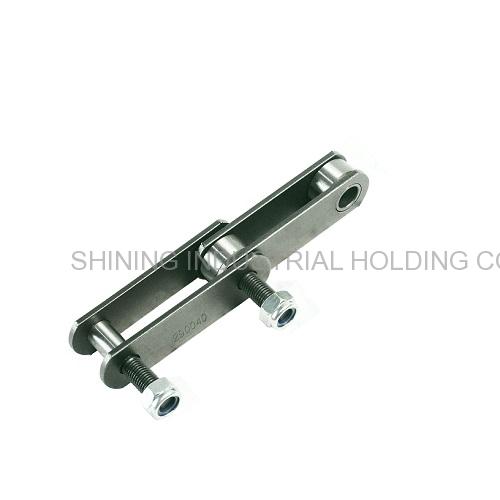
Pitch 4' conveyor chain for palm oil industry
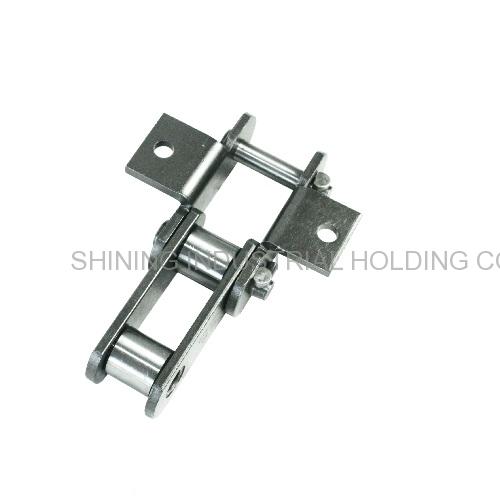
WRB9503 palm oil mill chain

600060 palm oil chain

WRB5289 palm oil chain
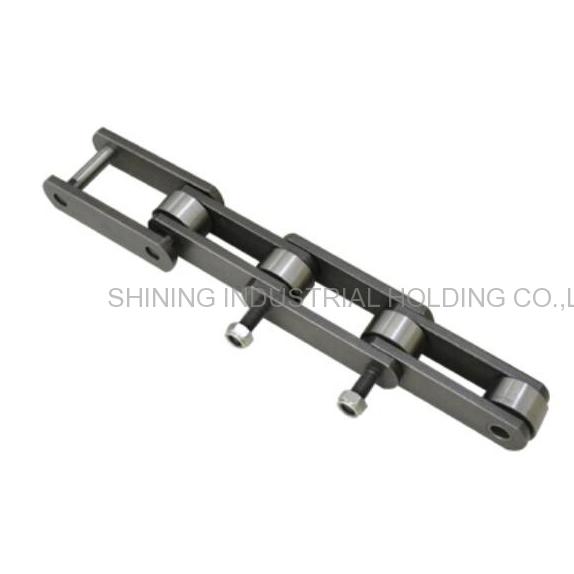
5289 Palm Oil Engineering Conveyor Chain
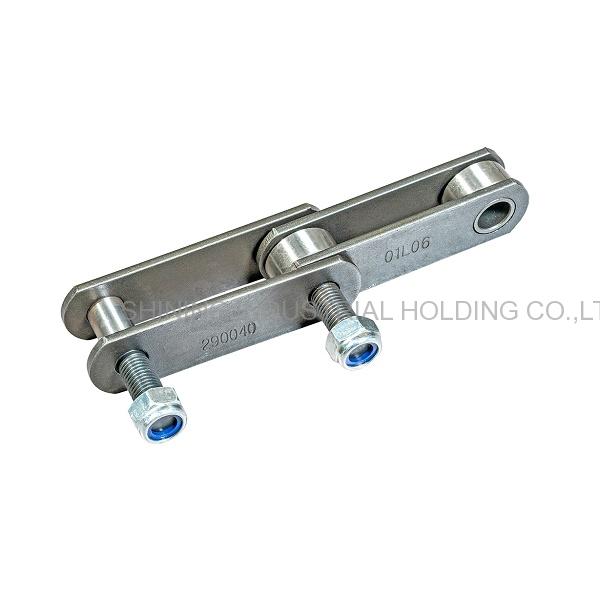
290040 palm oil chain with threaded pin
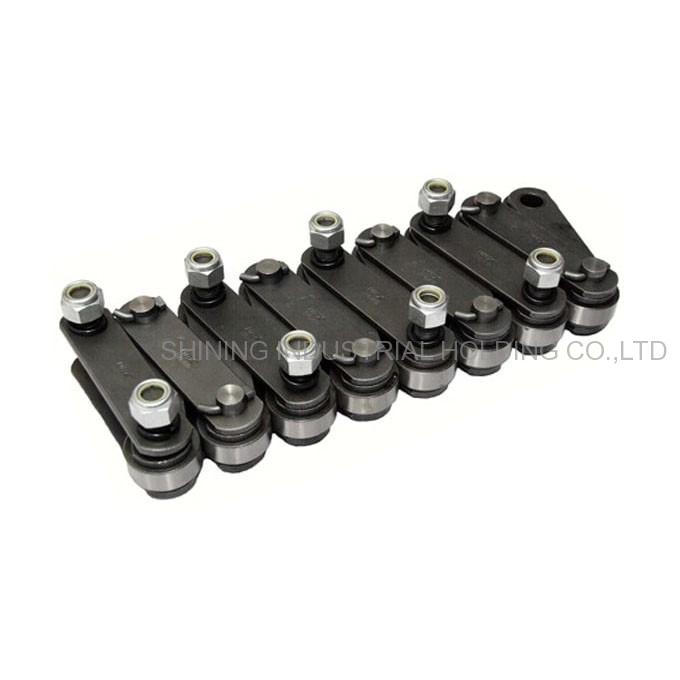
Palm Oil Conveyor Roller Chain

600060-B-16T Sprocket for Palm Oil Chains

600060 palm oil chain with threaded pin


